Valeo Unveils Cutting-Edge Automotive Innovations
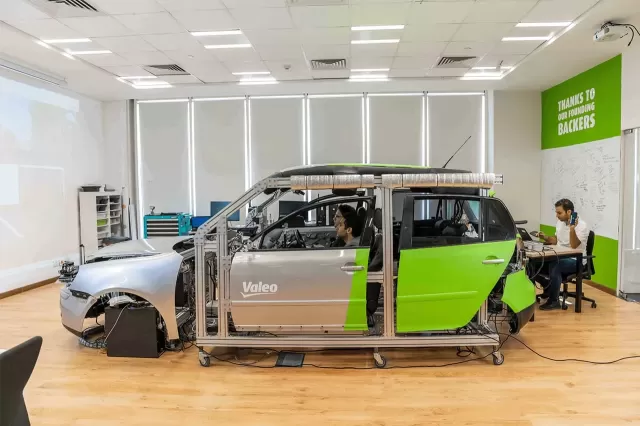
Valeo, a major global automotive supplier, recently showcased a range of innovative technologies at its Troy, Michigan, tech center. Aimed at enhancing vehicle performance, safety, and connectivity, these advancements span Valeo's core divisions of Power, Light, and Brain. Here's a look at some of the most promising concepts:
Revolutionary Fire-Resistant Battery Coolant
Addressing a crucial safety concern in electric vehicles, Valeo, in collaboration with TotalEnergies, has developed a groundbreaking fireproof battery coolant. Traditional coolants can become conductive if leaked, potentially causing battery short-circuits and fires. This new coolant is so safe that batteries and electric motor stators can be directly immersed in it.
- Enhanced Cooling: Direct contact allows for more efficient temperature regulation, critical for fast DC charging and preventing thermal runaway.
- Safe and Sustainable: The formula, kept under wraps by TotalEnergies, is reportedly organic, fully recyclable, and features a viscosity optimized for direct battery contact.
- Cost and Weight Optimization: Immersion cooling eliminates the need for secondary cooling circuits, reducing costs. While the fluid is denser, potentially increasing mass, the overall impact is expected to be minimal.
- Longevity: Valeo and TotalEnergies are targeting a 10-year service life, with the potential for a lifetime fill.
Software-Defined Windshield Wipers
Valeo's AquaBlade "wet wiper" concept, originally launched in 2012, is evolving with software-driven enhancements. The latest iteration features nozzle holes on both sides of the wiper blade, allowing the system to strategically spray the leading or trailing edge. New software programs, updatable over-the-air, add intelligent features:
- Clean4U Defrost: Activated during cold starts, this program sprays the leading edge of the wiper as it slowly moves up the windshield in increments, working in tandem with a windshield defrost program for rapid visibility restoration.
- Clean4U Debug: Designed for use during stops, this program sprays a "summer mix" of fluid from the trailing edge of the wiper as it incrementally advances, effectively breaking down bug enzymes for cleaner subsequent wipes.
These systems, one of which is already in production with Mercedes-Benz, improve visibility and support advanced driver-assistance systems (ADAS).
Future-Proofing Software-Defined Vehicles
Valeo presented forward-thinking electrical architecture concepts designed to maximize compatibility and adaptability in the software-defined vehicle (SDV) era. These solutions address the need for hardware and computing upgrades.
- Modular Computing: One concept provides space and a port for connecting additional centralized or zonal computing modules, enabling new features or handling increased processing demands. A demo showcased a system balancing the load between two modules and seamlessly transitioning mission-critical functions to a functioning module in case of failure.
- Scalable Architecture: Other concepts explored modular designs, allowing for the addition of computing power similar to adding cards to a computer motherboard. This approach enables manufacturers to use a common basic architecture across their product line, scaling up replaceable compute modules for higher-end models.
Solid-State "Auto Focus" Camera
Valeo's seventh-generation ADAS camera utilizes a solid-state "auto-focus" function to maintain image clarity over time.
- MEMS Technology: The system employs a micro-electronic mechanical system (MEMS), similar to those used in lidar units, to aim tiny mirrors and correct for age-related drift and misalignment of the image sensor with the lens.
- Precision Adjustment: With a stroke of 50 microns (0.00197 inch), the system provides sufficient correction, offering a simpler, cheaper, and more accurate solution compared to moving the lens.
5G-V2X for Vulnerable Road User Protection
Valeo, in collaboration with Verizon, is developing a system to protect vulnerable road users (VRUs) through 5G-V2X communication.
- VRU Detection and Communication: The system detects VRUs (bikers, pedestrians, children) and transmits their location via 5G-V2X. Detection can occur through a car's sensor suite, an intersection's smart camera, or direct communication from the VRU.
- Hyper Precise Location (HPL): Direct communication utilizes smartphones, smartwatches, or wearables with Verizon's HPL services, leveraging Real-Time Kinetics (RTK) to refine GPS location data down to centimeter accuracy.
- Driver Alerts and Avoidance: The VRU's location triggers a warning on the dashboard and/or activates braking or other avoidance technologies.
Valeo also introduced a flat smart antenna system that promises future non-terrestrial network (NTN, direct device-to-satellite) communications for internet-of-things devices and cell phones.